


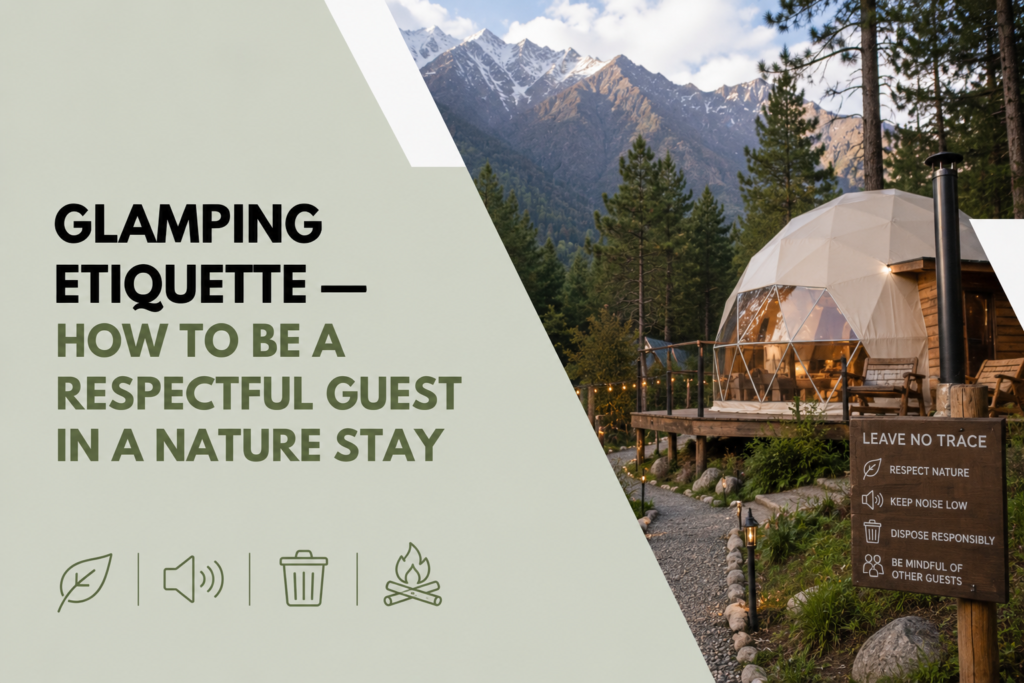


A pine forest and a mountain valley are not hotel lobbies. They have their own logic, and guests who understand it have a better stay.
Glamping etiquette is not a list of rules for their own sake. It exists because a nature stay at Khanabadosh Glamps, whether in Murree’s pine forest or Kumrat’s mountain valley, operates on different terms from a conventional hotel, and guests who arrive with those terms in mind consistently have a better experience. They also contribute to a better experience for everyone around them, and for the environment itself.
This guide covers the practical etiquette of being a good nature guest, simply and without moralising, because understanding it makes your stay better.
Noise — the most important principle
The primary offering of a Khanabadosh stay is the quality of the natural environment, pine forest at Murree, mountain valley and river at Kumrat. The soundscape of these environments, wind through trees, river water, birdsong, the particular silence of a mountain night, is both the background and the foreground of the experience. Guests who introduce competing noise affect not only their own stay but every guest within earshot.
- Keep music inside the unit at levels that don’t carry to adjacent clearings or units
- Outdoor conversations after 10pm should be at a volume appropriate to a shared natural space
- Children in outdoor areas should be supervised in ways that limit sustained noise from affecting the wider property
- Vehicle movement on property, arrival, departure, repositioning, should be slow and low-revving
“The guests who protect the quiet are protecting the most valuable thing on the property. It belongs equally to everyone staying there.”
The natural environment — how to be in it well
The pine forests of Murree and the mountain valley of Kumrat are not managed parks. They are functioning natural environments, and guests who walk trails or spend time outdoors are guests in the environment’s space rather than the other way around.
- Stay on marked trails — off-trail movement damages forest floor vegetation and ground-nesting bird habitat
- Do not remove plants, fungi, or any natural material — the cumulative impact of many guests doing this is significant
- Wildlife encountered — birds, insects, small mammals — should be observed and left undisturbed
- In Kumrat specifically, the river environment is sensitive — do not introduce waste, detergent, or food into the water
- Explain these principles to children before forest or riverside walks
Waste
- All waste goes in the bins provided. If the bin is full, inform property staff
- Food waste left outside attracts wildlife — an inconvenience for guests and a problem for the animals
- Bring a refillable water bottle — both Murree and Kumrat have clean mountain water available; minimise single-use plastic
- Cigarette ends are not biodegradable — never discard into forest floor, vegetation, or near the river at Kumrat. Fire risk in dry forest is serious and permanent
Respecting other guests
Khanabadosh properties have small unit counts by design. The behaviour of one party affects others more directly than in a large hotel. The private outdoor deck or garden of another unit is their space for the duration of the stay, do not enter it. Photography of other guests requires consent. Complaints about other guests are better raised with property staff than addressed directly.
Your unit — leave it as you found it
- Wet and muddy gear — shoes, jackets, should be left at the entrance, not brought inside. Timber interiors and dome flooring are difficult to clean after forest floor mud
- Candles, if provided, should never be left unattended — fire risk in a forest or mountain property is genuine
- Report accidental damage to property staff honestly
- Check out at the confirmed time — the preparation window for the next guest depends on it.
What is glamping etiquette?
Glamping etiquette is the conduct appropriate to a nature-based stay, respecting the natural environment, keeping noise at levels that don’t affect other guests, managing waste responsibly, and engaging with the forest or mountain setting in ways that preserve it. It differs from hotel etiquette in that the natural environment itself is a stakeholder in how you behave, not just the other guests and the property.
Can I play music outdoors at Khanabadosh Glamps?
Inside your unit, yes. Outdoors at levels that carry to other units or into the wider property, no. The natural soundscape of Murree’s pine forest and Kumrat’s mountain valley is the primary environmental amenity of each property. Outdoor music that competes with it affects every guest within earshot. Quiet hours apply from 10pm; the spirit of those hours applies throughout the stay.
Is glamping at Khanabadosh environmentally responsible?
Khanabadosh Glamps properties are positioned in natural environments with small unit counts, a format that limits infrastructure impact compared to conventional resort development. Individual guest behaviour determines how environmentally positive the experience is in practice: waste management, forest and river conduct, minimising single-use plastic, and leaving the natural environment undisturbed all matter and are within each guest’s control.
What should I do if I encounter wildlife during a forest walk at Khanabadosh?
Observe from a distance and do not approach, feed, or attempt to touch any wildlife encountered on trails at Murree or Kumrat. Most encounters will be birds, insects, or small mammals that pose no risk if left undisturbed. Keep children close during these moments rather than allowing them to chase or follow animals, as this causes stress to the wildlife and can lead to defensive behaviour.
How should I manage waste during a glamping stay?
Use the bins provided at your unit for all waste. If a bin is full, inform property staff rather than leaving waste outside it or in the surrounding forest. Food waste should never be left outdoors, as it attracts wildlife into guest areas. At Kumrat specifically, avoid letting any waste, soap, or detergent enter the river, the water source is shared by the local ecosystem and downstream communities.
Do children need special guidance on glamping etiquette?
Yes. Children naturally want to explore, collect, and interact with a new environment, and a short conversation before a forest or riverside walk goes a long way. Explain simply that plants and natural objects stay where they are, animals are watched rather than chased, and noise should stay low enough not to disturb other guests or the wildlife nearby. Most children adapt to this quickly once they understand the forest is a shared space, not a playground built for them alone.