
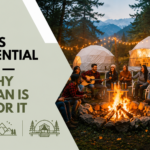



The shift from seeing places to being in them is the defining travel movement of this decade. Pakistan arrived early.
Experiential travel has become the dominant aspiration in global tourism, particularly among younger travelers, and the reason is straightforward once stated: people are less interested in the checklist and more interested in what a place makes them feel, think, and remember long afterward. The hotel room with a view has given way, as the primary travel ambition, to the stay that could not have happened anywhere else.
Pakistan has landscapes that are among the most dramatic on earth, accessible mountain environments within a few hours of its major cities, and a growing category of accommodation, exemplified by Khanabadosh Glamps in Murree and Kumrat, designed around the primacy of the natural environment. This combination makes it exceptionally well-positioned for experiential travel.
What experiential travel actually means in practice
The term is used loosely enough that it needs defining. Experiential travel is not adventure travel, though it can include it. It is not luxury travel, though it is compatible with luxury. It is travel where the depth of the experience in a place matters more than the number of places visited, where what you feel is the point, not what you’ve covered.
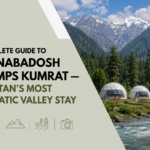
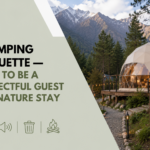
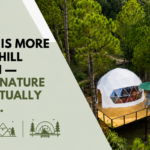
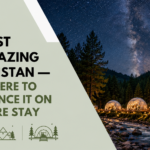
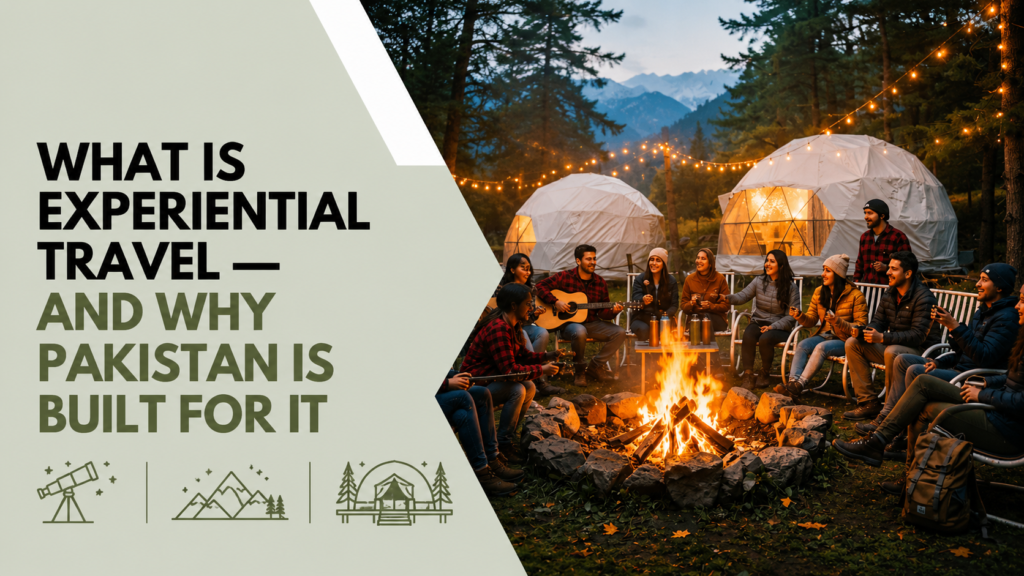
In accommodation terms: an experiential stay is one where the unit itself is part of the experience rather than a base from which to experience other things. A geodesic dome positioned in Kumrat’s mountain valley, with the river audible from the outdoor deck and snow-capped peaks across the view, is an experiential stay. The dome, its position, the valley it faces, these are not incidental to the trip. They are the trip.
“The most shared travel moments from Khanabadosh stays are not the planned activities. They are the unplanned ones, the morning mist in the Murree pines, the Kumrat river at dusk, the sky after the generator goes off.”
Why Pakistan specifically suits experiential travel
Extraordinary landscapes within reach
The pine forests of Murree and Patriata are under two hours from Islamabad. Kumrat valley, one of Pakistan’s most dramatic mountain environments, with a glacial river, dense forest, and peaks visible from the valley floor, is a single day’s drive. These landscapes are not behind a flight and a visa queue. They are accessible, and Khanabadosh Glamps positions you inside them at a standard of comfort that matches the quality of the environment.
The accommodation category has matured
Geodesic domes in Murree pine forests and Kumrat mountain clearings, wooden huts with private decks facing the valley, pods positioned for maximum environmental immersion, these are not improvised camping alternatives. They are a considered accommodation category that treats the natural environment as the primary product and builds the stay around it accordingly.
The natural assets remain underutilised
Pakistan’s mountain environments are significantly less crowded and more intact than equivalent landscapes in destinations with higher international tourist volumes. The Kumrat valley in particular offers a quality of mountain experience, open, dramatic, unspoiled, that is genuinely rare by global standards and currently accessible to a small fraction of the travelers it could serve.
What is experiential travel?
Experiential travel prioritises the depth and quality of experience in a single place over the number of destinations visited. It is travel oriented around what you feel, notice, and remember rather than what you’ve covered. In accommodation terms it means staying somewhere where the unit itself is part of the experience, as with Khanabadosh Glamps domes and huts in Murree and Kumrat.
Is Pakistan good for experiential travel?
Yes, significantly so. The combination of extraordinary accessible mountain landscapes, a growing category of experience-focused accommodation like Khanabadosh Glamps, and natural environments that remain less crowded than equivalent international destinations makes Pakistan particularly well-suited to the experiential travel category.
Why do younger travelers prefer glamping to hotels in Pakistan?
Because the experience differential is larger than the price differential, and because singular experiences retain value in memory and in how they’re shared. A night in a geodesic dome in Kumrat valley or a wooden hut in Murree‘s pine forest is specific to that place in a way that a hotel room with a mountain view is not, and that specificity is what younger travelers are actively seeking.