


Most people visit Murree and come back having seen the crowd. The mountain was there the whole time, behind it.
Murree has a reputation problem, not because the destination disappoints but because the standard experience of it consistently does. Mall Road, the traffic, the weekend crowds, hotels stacked against each other on the ridge, none of this is Murree’s fault. It is what happens when a genuinely beautiful place absorbs more visitors than its surface infrastructure can comfortably hold.
The actual Murree, the pine forest that predates the hill station, the ridgelines dropping into valleys, the dawn light through the canopy, the particular quality of silence that exists twenty minutes from the main road, remains intact and largely inaccessible to guests staying in town. Khanabadosh Glamps Murree exists specifically to close that gap, offering dome stays and wooden hut stays positioned inside the forest rather than beside it.
What Murree actually is, underneath the tourism
Murree sits at roughly 2,300 metres in the Pir Panjal range of the outer Himalayas. The surrounding forests, primarily chir pine and blue pine, cover terrain that has been forested continuously for far longer than the hill station has existed. These are not decorative trees lining a road. They are a functioning forest ecosystem with its own depth, its own light behaviour, and its own quality of silence.
The air at Murree altitude is measurably different from Islamabad, lower in particulate matter, noticeably cooler, and more oxygenated. This is not poetic description. It is a physical fact that becomes apparent within the first hour of arrival and more pronounced the further into the forest you go.
Why the standard visit misses it
The hill station model was designed for mass tourism and delivers on those terms competently. What it was never designed to do is provide access to the natural environment that made Murree valuable in the first place. A guest in a town hotel experiences the mountain as a backdrop. The forest is technically visible. But it is not accessible, it is past the car park, down a road, through a crowd, and by the time logistics resolve themselves the afternoon light has moved on.
“The Murree most visitors came for is not on Mall Road. It is in the forest behind it, and Khanabadosh puts you there directly.”
What a dome or wooden hut stay at Khanabadosh Glamps Murree gives you
The forest, immediately on arrival
Domes and wooden huts at Khanabadosh Glamps Murree are set in forest clearings. From the moment you arrive, the forest is not a destination, it is where you are. The smell of pine resin, the filtered light through canopy, the temperature dropping as you step out of the car, all of this is present without a plan, a walk, or a navigation effort.
The morning
Murree mornings in forest clearings, particularly in spring and autumn, have a quality that the standard hill station visit almost never accesses. Mist moving through pine canopy at six in the morning, the light coming in low and golden through the trees, the forest still cold from the night. From a dome or hut deck at Khanabadosh, this is what you wake up to. In a town hotel, it is what was happening while you were in a corridor waiting for the lift.
The quiet
Genuine quiet, the kind that lets you hear the forest rather than the infrastructure around it, exists in Murree. It is simply inaccessible from town. At Khanabadosh Glamps Murree, the quiet is the default condition. The forest sounds replace the urban sounds. This is both the purpose and the outcome of positioning an accommodation property in a forest clearing rather than on a commercial ridge.
Patriata, Murree’s quieter alternative
Patriata, a short drive along the ridge from Murree town, offers equivalent forest and mountain scenery with a fraction of the visitor volume. The Khanabadosh Glamps Murree properties in this area sit in a version of the same mountain environment without the commercial layer. For guests whose primary concern is natural immersion, Patriata is often the more rewarding position, particularly on peak summer weekends when Murree town is at maximum capacity and the road is a queue.
What accommodation does Khanabadosh offer in Murree?
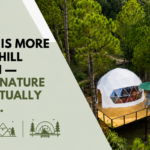
Khanabadosh Glamps Murree offers geodesic dome stays and wooden hut stays, both positioned in pine forest clearings with private outdoor decks, ensuite bathrooms, heating, and hotel-grade bedding. These are the only two accommodation formats at the Murree location, pods, chalets, and family chalets are available at Kumrat.
How do I avoid the crowds in Murree?
Stay in a forest nature property set back from Murree town rather than a hotel on or near Mall Road. Visit in shoulder seasons, April to June or September to October, rather than peak July-August school holidays. Leave Islamabad on Friday evening rather than Saturday morning to avoid peak road traffic.
Is Patriata better than Murree for a nature stay?
For guests prioritising the natural environment over town amenities, Patriata offers equivalent landscape quality with significantly fewer visitors. The Khanabadosh Glamps Murree properties in the Patriata area give guests the forest experience without the congestion of Murree town proper, particularly valuable on peak summer weekends.