



The opposite of a checklist holiday. And considerably better.
Slow travel is one of those concepts that sounds self-evident once you encounter it and slightly embarrassing to admit you hadn’t been doing before. It is, at its core, a simple idea: go to fewer places, stay longer, pay more attention. Arrive somewhere and actually be there, rather than documenting that you arrived and moving to the next location.
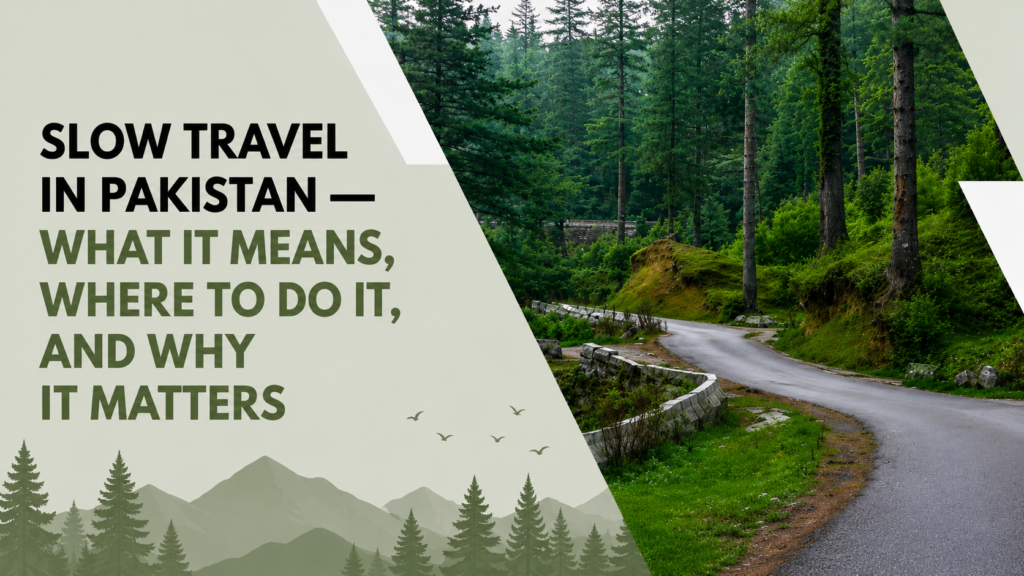
In Pakistan, a country with some of the world’s most extraordinary landscapes, slow travel is not just a preference but an argument. The mountains of the north are not a checklist destination. They are a place to be in, and the experience of being in them is categorically different from the experience of passing through them.
What slow travel actually means in practice
The term has been used to mean many things, most of them vague. In practical terms, slow travel involves a few specific choices:
- Fewer destinations, more time in each — a weekend in one location rather than three nights across four places
- Accommodation that belongs to the environment — staying somewhere that gives you the place rather than a room near the place
- An itinerary with room in it — not every hour accounted for, not every sight ticked off
- Attention as the primary activity — noticing the light, the temperature, the sounds, ambiance and the way the environment changes through the day
This last point is the hardest for most people, because attention is precisely what city life has systematically trained out of us. The phone, the notifications, the ambient noise, these are not just distractions. They are an alternative architecture of experience, and dismantling it takes more than intention. It takes a change of environment.
Why Pakistan is particularly suited to slow travel
The northern regions of Pakistan, the pine forests of Murree and Galiyat, the ridges above Patriata, the valleys of Kumrat and Swat, are landscapes that reward the patient traveler disproportionately. They are not destinations that reveal themselves to people passing through. They reveal themselves to people who stop.
The quality of light at different hours in a pine forest is genuinely extraordinary, and completely inaccessible to guests who arrive at noon and leave at four. The way mist moves through a mountain valley at dawn is one of the more reliably moving natural experiences available within two hours of Islamabad, and it is available only to the person who was there the night before and woke up early enough to see it.
“Pakistan’s mountains don’t perform for passing visitors. They open for people who arrive without a schedule and give them enough time to notice.”
Luxury nature stays as the infrastructure of slow travel
The structural problem with slow travel intentions is that most accommodation is designed for efficient visits rather than prolonged presence. A hotel room is optimised for sleeping and leaving. The incentives, checkout time, dining schedules, the general social pressure of a busy property, push you outward rather than inviting you to stay.
Nature stays, domes, wooden huts, pods, and chalets at properties like Khanabadosh Glamps, are structurally different. The accommodation is the experience rather than the base for it. Your outdoor deck is the place you spend the morning, not the view you glimpse between activities. The forest clearing is the point, not the backdrop.
This makes luxury nature stays the most natural infrastructure for slow travel in Pakistan. Not because they are designed around a philosophy, but because the format, a private unit in a natural setting with no competing resort activities, creates the conditions for slow travel without requiring you to enforce them.
Slow travel by accommodation type
Dome stays
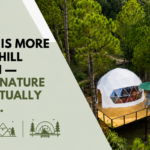
The dome format is inherently slow, there is nowhere to be except inside the dome or on the deck, and both orientations face outward. The dome structure with transparent view frame means the environment is constantly present, constantly changing, and consistently more interesting than whatever you might otherwise occupy yourself with.
Wooden huts
The sensory richness of a timber interior, smell, sound, texture, is actively engaging in a way that plastic and plaster are not. Wooden hut stays tend to produce a quality of presence in guests simply by offering an environment that repays attention.
Family chalets
Slow travel with children is both harder and more rewarding than without. Children in a natural environment slow down in a specific way, they find things, follow things, observe things at a pace that adults have usually lost. A family chalet stay in a forest is slow travel as it was originally practiced, before it needed a name.
How to actually do slow travel in Pakistan
The practical steps are simpler than the philosophy:
- Book two nights minimum — one night is a visit, two nights is a stay
- Leave Saturday morning from Islamabad rather than Friday evening, to avoid the traffic at its worst
- Download offline content before you leave — don’t plan to stream
- Bring one book, not a reading list
- Leave the itinerary loose — the best slow travel experiences are the ones that weren’t planned
What is slow travel and why is it becoming popular?
Slow travel is an approach to travel that prioritises depth over breadth, fewer destinations, longer stays, and more deliberate attention to the environment you’re in. It has grown in popularity as a response to the over-scheduled, checklist-oriented travel style that social media tends to encourage, and as research on nature immersion and digital disconnection has made its benefits clearer.
Where is the best place for slow travel in Pakistan?
The pine forest regions of northern Pakistan, Murree, Galiyat, Patriata, are among the most accessible and rewarding destinations for slow travel from Islamabad. For the long drive lovers, Kumrat is the absolute spot with riverfront and nature-centric experience. The landscapes reward attention and presence over speed, and luxury nature stays in forest settings provide the accommodation infrastructure to make genuinely slow travel possible.
Is slow travel possible on a short trip in Pakistan?
Yes, slow travel is more about approach than duration. A two-night stay at a forest property near Islamabad, with a deliberately unscheduled itinerary, constitutes slow travel in the meaningful sense. The key is choosing accommodation that belongs to the environment rather than one that sits near it.
What type of accommodation suits slow travel best in Pakistan?
Luxury nature stays, domes, wooden huts, pods, and chalets at properties like Khanabadosh Glamps, are the most structurally suited accommodation for slow travel. The private unit in a natural setting with no competing resort activities creates the conditions for genuine presence without requiring it to be enforced by willpower.