

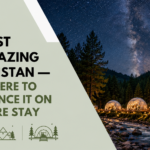



Cities have taken the night sky from most of us. Pakistan’s mountains still have it. Here’s how to actually be under it.
Most people living in Pakistan’s major cities have not seen a genuinely dark sky in years. Islamabad, Lahore, Karachi, the ambient light of urban infrastructure reduces the night sky to a muted, partial thing. A few bright stars, the moon when visible, and a general orange glow across every horizon. The Milky Way, which ought to be one of the most readily available spectacles in nature, is invisible from anywhere with meaningful city light.
Pakistan’s northern mountain regions are categorically different. At altitude, away from town centres, the night sky over Murree’s pine forests and Kumrat’s open mountain valley is among the darkest and most star-rich in Asia. At Khanabadosh Glamps, outdoor decks at both locations put you directly under that sky, no equipment required, no special access needed.
Why Pakistan’s mountain sky is extraordinary
Several factors combine to produce genuinely exceptional stargazing conditions in Pakistan’s northern regions:
- Low light pollution — the Galiyat range around Murree and Kumrat valley are both far enough from major urban centres to have minimal ambient artificial light
- Altitude — higher elevation means less atmospheric interference; stars appear brighter and more numerous
- Air quality — mountain forest air in northern Pakistan is significantly cleaner than urban air, producing clearer seeing conditions
- Open sky positioning — Kumrat’s open valley offers particularly unobstructed sky views; Murree’s forest clearings provide good visibility in the gaps between canopy
On a clear, moonless night at either location, the Milky Way is visible to the naked eye as a distinct band across the sky. This is not photographic exaggeration. It is what the sky looks like when there is no city within meaningful range.
Stargazing at Khanabadosh Glamps, what the experience actually is
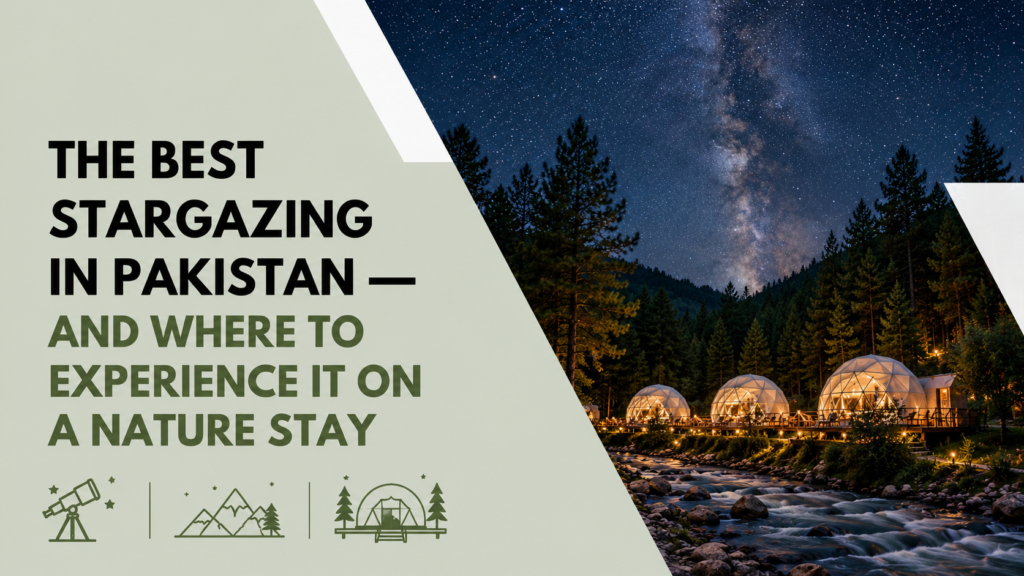
The domes at Khanabadosh Glamps are geodesic structures, solid, engineered, opaque. The stargazing experience at Khanabadosh is not from inside the dome looking up through a transparent roof. It is from the outdoor deck that every unit comes with, facing an open sky in a forest clearing or open valley, with no city light competing for your attention.
This distinction matters because outdoor stargazing in Pakistan’s mountain regions, when you are in the right location with the right conditions, is a genuinely extraordinary experience. The dome’s outdoor deck, positioned in a cleared forest space at Murree or alongside the river at Kumrat, puts you under the full sky in a private setting. What you see on a clear night is the consequence of where you are, not what the architecture allows.
Murree, forest stargazing
Murree’s pine forest clearings offer good night sky conditions with the forest providing natural shelter and enclosure. The sky visible from a dome or hut deck at Khanabadosh Glamps Murree is significantly better than anything available in Islamabad. The forest creates a specific atmosphere, the sound of wind through pine at night, cold air, a dark sky overhead, that makes the stargazing experience richer than a simple view from an open field.
Kumrat, open valley stargazing
Kumrat’s open mountain valley offers the most unobstructed sky access of any Khanabadosh location. Without the pine canopy that partially frames the sky at Murree, the full arc of the night sky is visible from the outdoor deck of any unit. The Kumrat valley’s remoteness, several hours from major urban centres, means the light pollution baseline is lower than at Murree. For guests specifically prioritising night sky quality, Khanabadosh Glamps Kumrat delivers the best conditions.
“The outdoor deck of a dome in Kumrat valley, on a clear October night, gives you a sky that most people living in Pakistan’s cities have genuinely never seen. The Milky Way is not a metaphor. It is overhead and unmistakeable.”
Best seasons for stargazing at Khanabadosh
April to early June
Post-winter clarity, lower cloud cover than monsoon months, comfortable outdoor temperatures for deck time after dark. The optimal window for combining good sky conditions with pleasant night-time outdoor experience.
September to October
Post-monsoon clarity produces some of the best night sky conditions of the year. October in particular delivers exceptional stargazing, low humidity, clear atmosphere, and temperatures that make an hour on the outdoor deck a genuine pleasure rather than a cold endurance. The best overall window for stargazing at both locations.
Mid-monsoon (July to August)
Cloud cover during monsoon is significant and persistent. Stargazing is possible on clear nights but cannot be relied upon for planning purposes.
Winter (November to February)
Clear winter nights at altitude can produce extraordinary sky conditions. The outdoor component requires warm clothing; both Murree and Kumrat are cold after dark in winter months. But the sky on a clear winter night in Kumrat valley is among the most remarkable available in Pakistan.
How to maximise your stargazing experience
- Check the lunar calendar before booking — a full moon significantly reduces star visibility; new moon periods give the darkest skies
- Allow twenty minutes outside before dark-adapting — white light from a phone resets adaptation immediately
- Book shoulder seasons (April–June or September–October) for highest probability of clear nights
- For maximum sky access, Kumrat’s open valley is the better location over Murree’s forested setting
- Bring a warm jacket regardless of season — outdoor deck time after midnight is cold at mountain altitude
Can you see the Milky Way from Murree and Kumrat in Pakistan?
Yes, in locations set back from town centres with minimal ambient light, the Milky Way is visible to the naked eye on clear, moonless nights. Kumrat‘s open valley and greater remoteness from urban centres gives better sky conditions than Murree, though both are dramatically superior to any city sky. The best conditions occur in the shoulder seasons of spring and autumn.
Where is the best stargazing in Pakistan on a glamping trip?
Khanabadosh Glamps Kumrat offers the best stargazing conditions among the brand’s locations, the open valley provides unobstructed sky access and the distance from major urban centres means lower light pollution than Murree. Outdoor decks at every unit place you directly under the sky in a private setting. Khanabadosh Glamps Murree also offers good sky conditions from dome and hut decks in forest clearings.
Is stargazing possible from inside the domes at Khanabadosh?
No, Khanabadosh domes are geodesic structures with solid walls, not transparent roof panels. The stargazing experience at Khanabadosh Glamps is from the private outdoor deck that every unit includes. The deck, positioned in a forest clearing at Murree or open valley at Kumrat, puts you directly under a dark mountain sky with privacy and no light competing for your view.
What time of year is best for stargazing near Murree and Kumrat?
September and October are the best months, post-monsoon clarity produces some of the most reliable and dramatic night sky conditions of the year. April to early June is the second best window. Mid-monsoon months (July–August) have significant cloud cover. Winter nights can be exceptional but require warm clothing for the outdoor component.