






There is something about timber in the mountains that glass and concrete simply cannot replicate.
Before domes and designer pods became the vocabulary of luxury nature stays, the cabin in the forest was the original promise, a warm, solid, human-made structure placed inside a landscape that dwarfs it. A place to sleep and eat and be, surrounded by something older and larger than the building itself.
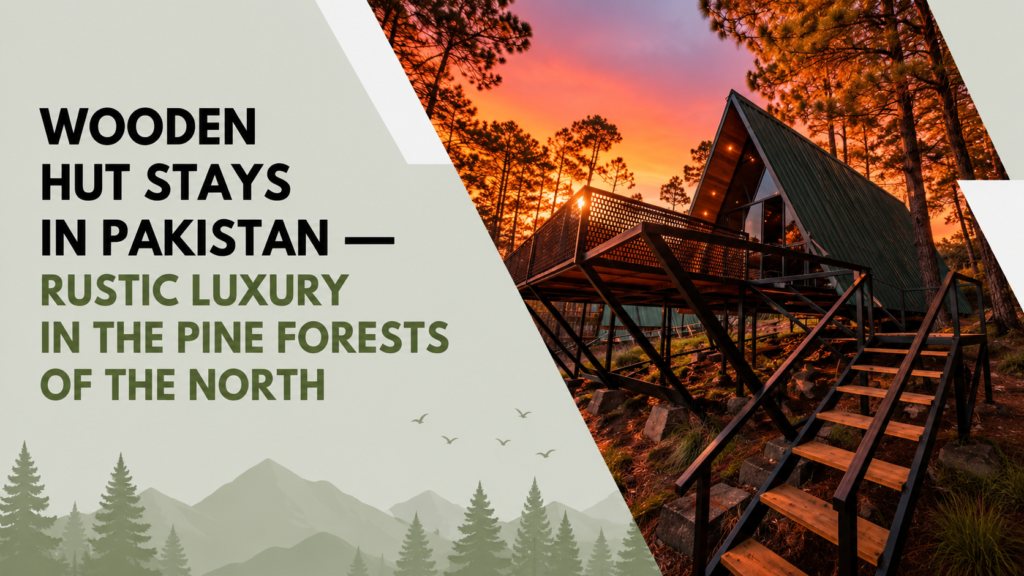
Wooden hut stays in Pakistan’s northern forests are the contemporary version of this idea. Not rustic in the sense of compromised, but rustic in the original sense made of material that belongs to the environment it sits in, built with attention to the relationship between interior warmth and exterior cold, designed to feel like it grew from the ground rather than was delivered to it.
What a wooden hut stay actually offers
The wooden hut format at Khanabadosh Glamps is a fully appointed accommodation, private bathroom with hot water, proper bed with quality linen, heating, and furnishings in natural materials, housed in a timber structure set into a forest clearing. The distinction from a dome or pod is primarily sensory and material: you are in wood rather than glass or composite, and this changes the experience in ways that are difficult to anticipate and immediately obvious on arrival.
Timber has a smell. It has a particular acoustic quality; sounds are absorbed differently in a wood-lined interior. The warmth of a wooden structure in cold mountain air has a specific quality, somewhere between a well-built house and a vessel, something that holds heat and occupants in a way that feels intentional.
The sensory experience, why material matters
Travel accommodation has spent the last two decades moving toward glass, steel, minimal surfaces, and neutral palettes. The aesthetic is clean and photogenic. It is also, in mountain forest environments, slightly at odds with the setting.
A wooden hut is the opposite approach. The material vocabulary of the structure, timber beams, wooden flooring, natural grain on the walls, belongs to the same world as the trees outside. You are not observing the forest from an architectural object that contrasts with it. You are in something that continues it.
“A well-built wooden hut in a forest smells like the trees it was made from and the ones it sits among. This is not a small thing.”
Wooden hut vs dome, choosing the right format
The choice between a wooden hut and a dome at Khanabadosh comes down to what you’re primarily seeking from the experience:
- If the night sky and stargazing are the primary draw, a dome stay with transparent roof panels gives you something a wooden hut cannot
- If warmth, enclosure, and the specific cosiness of a timber interior in cold mountain air are what you’re after, a wooden hut delivers this more completely than any glass structure
- For winter stays specifically, a wooden hut’s thermal character makes it the more comfortable choice, timber retains and radiates heat differently from glass or composite panels
- For couples seeking romance through visual drama, the dome. For couples seeking romance through warmth and enclosure, the wooden hut
Who wooden hut stays suit best
Couples seeking warmth over drama
Not every couple wants to feel like they’re in an architectural statement. For pairs who travel for comfort, conversation, and the particular pleasure of being warm inside while something cold and beautiful happens outside, a wooden hut is the more emotionally resonant choice.
Guests visiting in autumn or winter
Wooden huts are the most seasonally versatile accommodation format at Khanabadosh. They perform well in all seasons but are particularly suited to colder months when the warmth of the structure itself becomes a primary feature of the experience.
Guests who prefer natural materials
There is a growing category of traveler who actively seeks spaces made of natural materials, timber, stone, natural textiles, and finds the minimalist glass-and-composite aesthetic of contemporary glamping slightly cold. Wooden hut stays are the natural accommodation choice for this sensibility.
What mornings look like in a forest hut
You wake up in timber. The light comes in differently than it does through a dome panel, filtered, directional, through windows placed to frame the forest rather than expose it. The temperature outside the duvet is noticeably colder than the temperature inside it, which is one of the more reliable morning pleasures available in mountain travel. Eventually you have a cup of tea or coffee. You open the door to the deck and stand in cold air with something warm in your hands looking at a pine forest doing whatever it does at that hour. This is, it turns out, enough.
What is a wooden hut stay in Pakistan like?
A wooden hut stay at Khanabadosh Glamps is a fully appointed accommodation in a timber structure set in a pine forest clearing. It includes a proper bed, private bathroom with hot water, heating, and natural material furnishings. The experience is warmer and more enclosed than a dome stay, the material quality of the timber interior is a significant part of the appeal.
What is the difference between a wooden hut and a dome stay?
A dome stay prioritises space and outside views, the curved glass or composite frame allows forest gazing from the bed. A wooden hut prioritises warmth, enclosure, and natural material immersion. Both offer equivalent luxury standards; the choice depends on whether you want to look outwards or be held inside something warm and solid.
Are wooden hut stays good in winter in Pakistan?
Yes, wooden hut stays are among the most suitable accommodation formats for winter mountain stays in Pakistan. Timber retains and radiates heat effectively, and the visual experience of a pine forest in snow viewed from a warm wooden interior is one of the more underrated experiences in Pakistani mountain tourism.
Where can I book a wooden hut stay near Islamabad?
Khanabadosh Glamps offers wooden hut accommodations in pine forest settings accessible from Islamabad within approximately two hours. Check current availability and booking details on the Khanabadosh website for the most accurate information.